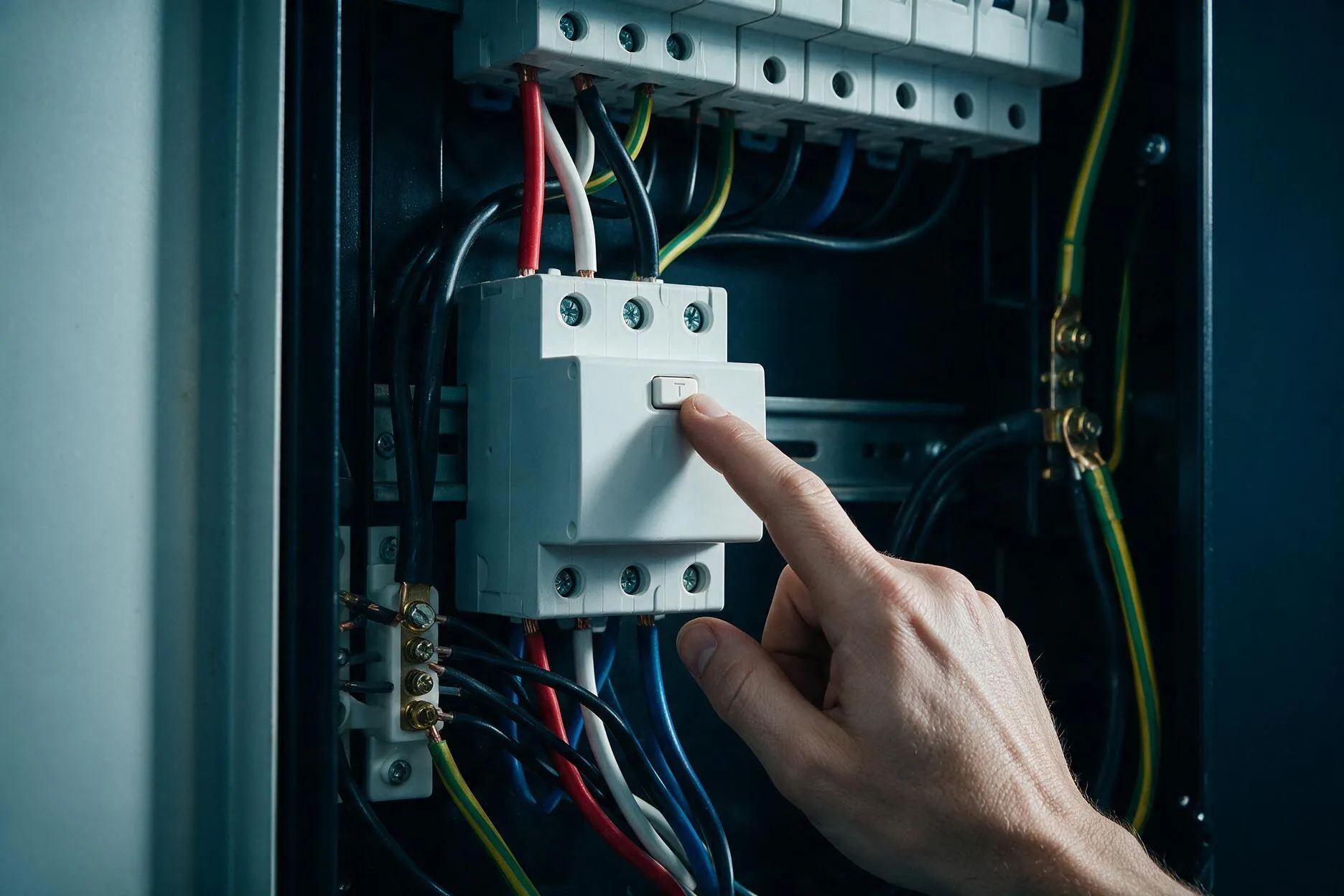
RCD & Safety-Switch Testing
A safety switch is the device that saves your life if you touch something live — but only if it's actually working. We test both the mechanism and the trip time, to AS/NZS 3760.
An RCD — residual current device, or "safety switch" — constantly watches the current flowing out and back on a circuit. The instant it detects a leak to earth, like current running through a person, it cuts the power in a fraction of a second. It's separate from your circuit breakers, which protect your wiring and equipment, not people — you need both, and having breakers doesn't mean you have safety-switch protection.
The push-button test
Press the test button on the switch — the power to that circuit should cut out immediately. It confirms the mechanism moves, nothing more. No licence required, but it doesn't tell you whether the switch trips fast enough to actually protect someone.
The trip-time test
Using a calibrated instrument, we measure how fast the RCD actually trips under a real fault — which is what keeps you alive. Passing the button test doesn't mean it trips fast enough; this is the test that confirms compliance.
Testing intervals & maximum trip times
Push-button test intervals
| RCD type | Interval |
|---|---|
| Portable RCDs | Every 3 months (construction/high-risk: daily or before each use, whichever is longer) |
| Fixed RCDs (switchboard) | Every 6 months |
Trip-time test intervals
| RCD type | Interval |
|---|---|
| Portable RCDs | Every 6 months (construction: 3 months; some low-risk 12 months) |
| Fixed RCDs — commercial / industrial | Every 12 months |
| Fixed RCDs — residential-type / low-risk | Up to 2 years |
Maximum trip times
| RCD type | Must trip within |
|---|---|
| Type II (30 mA) | 300 ms |
| Type I (10 mA) | 40 ms |
Please note: These intervals are indicative, based on AS/NZS 3760:2022 (Table 2.4) and related standards. They are minimum recommendations — your actual interval must be set by a documented risk assessment for your specific site and may be shorter. This is general guidance only and is not a compliance determination for your workplace. Contact us for a site-specific assessment.
What a failed RCD means
If a safety switch fails a trip-time test, it's taken out of service immediately — it's no longer doing its job, even if it "works" when you press the button. Nuisance tripping is a different signal worth listening to: it usually means the switch is doing its job and catching a genuine leakage somewhere, not that it's faulty. Repeatedly resetting it without finding the cause is the wrong move.
- Dust, moisture and age can slow a mechanism down without any outward sign.
- A switch that worked years ago can now trip too slowly — or not at all.
- An untested safety switch is one you're trusting on faith.
Don't wait for a fault to find out.
We test both the mechanism and the trip time, flag anything non-compliant, and give you a certificate you can actually rely on.
An untested safety switch is a gap in your cover
WHS law puts a duty of care on you to keep electrical equipment safe and maintained, and commercial insurance policies commonly require it. If a fault is ever traced to a switch that wasn't tested on schedule, that's the first thing an insurer checks. Every RCD test we do comes with a certificate that proves you met your obligation.
Related services
Safety switch testing — common questions
What is an RCD (safety switch)?
An RCD — residual current device, or "safety switch" — is the device that saves your life if you touch something live. It constantly watches the current flowing out and back on a circuit, and the instant it detects a leak to earth (like current running through a person), it cuts the power in a fraction of a second.
What's the difference between a safety switch and a circuit breaker?
They protect different things. A circuit breaker protects the wiring and equipment from overload and short circuits — it stops your cables cooking. A safety switch (RCD) protects people from electric shock. You need both, and having breakers does not mean you have safety-switch protection.
How often should safety switches be tested?
Two different tests, two different schedules. The push-button test — anyone can do it — should be done every 3 months on portable RCDs and every 6 months on fixed ones in the switchboard. The proper trip-time test, done by a competent person with a calibrated tester, is typically every 12 months for fixed switchboard RCDs.
What's the difference between the push-button test and the trip-time test?
The push-button test just checks the mechanism trips — you press the button, the power should cut out. It tells you the switch moves, nothing more. The trip-time test uses an instrument to measure how fast it trips under a real fault, which is what actually keeps you alive. Passing the button test doesn't mean it trips fast enough.
How do I know if my safety switch is actually working?
Press the test button — the power to that circuit should cut out immediately. If it doesn't, or if the button trips but the power stays on at the outlets, call an electrician straight away. Press-button testing only confirms it moves, though — only an instrument trip-time test confirms it trips fast enough to protect you.
Why does my safety switch keep tripping for no reason?
Nuisance tripping usually means the switch is doing its job — it's catching a genuine small leakage to earth somewhere, often a faulty appliance, a damaged lead, or moisture in a circuit. Repeatedly resetting it without finding the cause is the wrong move; the trip is a warning, not a glitch. Get it investigated.
Do safety switches wear out?
Yes. Dust, grit, moisture and simply sitting unused can cause the internal mechanism to stick or slow down over time, so a switch that worked years ago may now trip too slowly — or not at all. That's the whole reason for regular trip-time testing: an untested safety switch is a safety switch you're trusting on faith.
How fast is a safety switch supposed to trip?
Fast — faster than you can blink. Under AS/NZS 3760, a standard 30mA safety switch must trip within 300 milliseconds (0.3 of a second) at its rated current, and a more sensitive 10mA device within 40 milliseconds. Anything slower than that is non-compliant and has to be taken out of service.
Book your RCD testing
Tell us how many switches and where — we'll come back with a straight quote, promptly.
- Straight quote based on number of switches
- Booked in as soon as we can fit you in
- Certificate provided on completion
Three things I put in writing
Every quote you get from an electrician looks the same from the outside. Here's what's different about this one — and none of it depends on anyone but me.
The Fixed Price Promise
One fixed price for the work that needs doing.
I check the job properly before quoting, so the price covers everything it needs — no surprises on the day. If I find extra work once I'm there, I'll tell you and price it separately before doing it. You're never billed for something you didn't agree to first.
The On-Time Promise
Inside the booked window, or $50 off the job.
You get a booked window, not a vague day. If I'm not there inside it, I take $50 off the job. No excuses and nothing for you to chase.
Lifetime Workmanship Warranty
If it fails because of how I fitted it, I fix it free.
Every install is backed for as long as you own the place. If something I fitted fails because of the workmanship — not a storm event, not a manufacturer fault — I come back and make it right at no charge.